For decades, luxury was defined by hotel lobbies polished to perfection, uniform service rituals, and the quiet certainty that everything would be handled for you. But today, something subtler is reshaping the way affluent travelers move through the world.
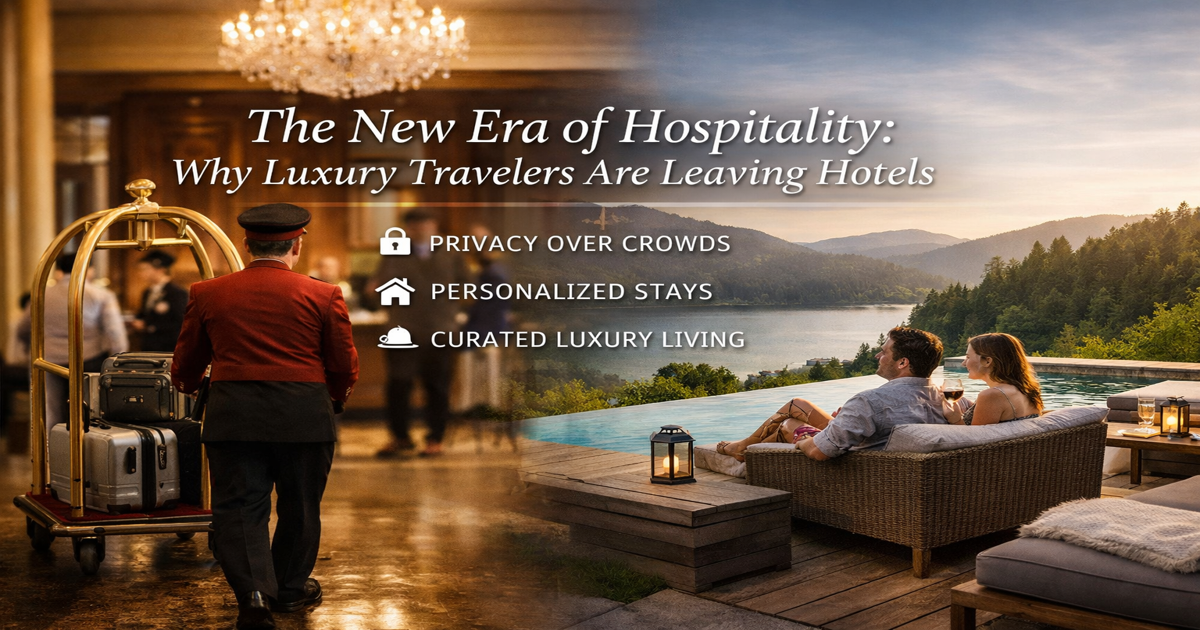
The New Era of Hospitality: Why Luxury Travelers Are Leaving Hotels
For decades, luxury was defined by hotel lobbies polished to perfection, uniform service rituals, and the quiet certainty that everything would be handled for you. But today, something subtler is reshaping the way affluent travelers move through the world. The most discerning guests are not abandoning luxury. They are redefining where they find it.
What they are leaving behind is not comfort, but convention.
Privacy Has Become the New Luxury Standard
The clearest shift in high-end travel is the growing preference for privacy over visibility. Luxury travelers increasingly view traditional hotels as too public, too structured, and in some cases, too shared to feel truly restorative.
Instead, they are gravitating toward spaces that feel entirely their own. Private villas, branded residences, and full-service estates now offer what hotels struggle to replicate at scale: uninterrupted space, controlled access, and complete discretion.
Industry analysis shows that ultra-wealthy travelers are prioritizing seclusion and personalized environments over recognizable hotel brands, often paying significant premiums for fully private stays staffed by private chefs, security, and dedicated teams rather than rotating hotel personnel. ([Business Insider][1])
Privacy is no longer a feature of luxury. It is the foundation of it.
From Hotel Rooms to Living Spaces
Luxury accommodation is expanding beyond the traditional hotel model into something more fluid and residential. The most desired stays now feel less like a visit and more like a temporary home designed at the highest level.
This shift is driven by a deeper behavioral change: travelers are staying longer, traveling with family or groups more often, and seeking environments that support daily life rather than interrupt it.
Private villas and serviced homes are leading this evolution, offering space to cook, gather, work, and unwind without the formality of hotel schedules or shared amenities. The result is a quieter, more personal rhythm of travel where the experience unfolds on the guest’s terms, not the property’s.
The Rise of Curated Independence
Modern luxury travelers are not rejecting service. They are rejecting friction.
Where hotels once defined luxury through constant attention, today’s guests prefer something more refined: invisible service that appears only when needed. This includes private concierges, pre-arrival customization, and seamless digital coordination that removes the feeling of being managed.
The most successful hospitality models now combine autonomy with access. Guests want the freedom of a private residence with the reassurance that a world-class team is quietly available behind the scenes.
This “best of both worlds” approach is becoming a defining standard of modern high-end hospitality, where discretion and responsiveness matter more than visible formality.
Why Hotels Are Losing Their Monopoly on Luxury
Hotels are not disappearing from luxury travel, but their role is changing. Large properties are adapting by introducing membership clubs, branded residences, and hybrid hospitality models that blur the line between guest and local experience.
Even major hospitality brands are expanding into yachts, private jets, and residence-style offerings, acknowledging that the modern luxury traveler expects experiences that extend beyond a single building or check-in desk.
At the same time, affluent travelers are increasingly influenced by the idea that true luxury is not about shared spaces, but about curated environments that feel personally designed and emotionally calm.
A More Intentional Way to Travel
Perhaps the most important shift is psychological. Luxury travel is becoming less about display and more about restoration.
Guests are choosing environments that support slower mornings, longer stays, and more meaningful time with the people they travel with. The emphasis is moving away from spectacle and toward stillness, privacy, and ease.
This is not a rejection of hospitality. It is a refinement of it.
A Quiet Redefinition of Where Luxury Lives
The future of hospitality is not anchored in lobbies or room categories. It is shaped by how a space makes someone feel when no one is performing for them.
For many travelers, that feeling is now found outside traditional hotels, in private homes and curated residences where service is present but never intrusive, and where luxury is measured in silence, space, and control over one’s own time.
In that sense, hotels are not being abandoned. They are being reimagined from the outside in.
And for those who understand this shift, the most compelling stays are no longer about checking in. They are about arriving somewhere that already feels like it belongs to you.